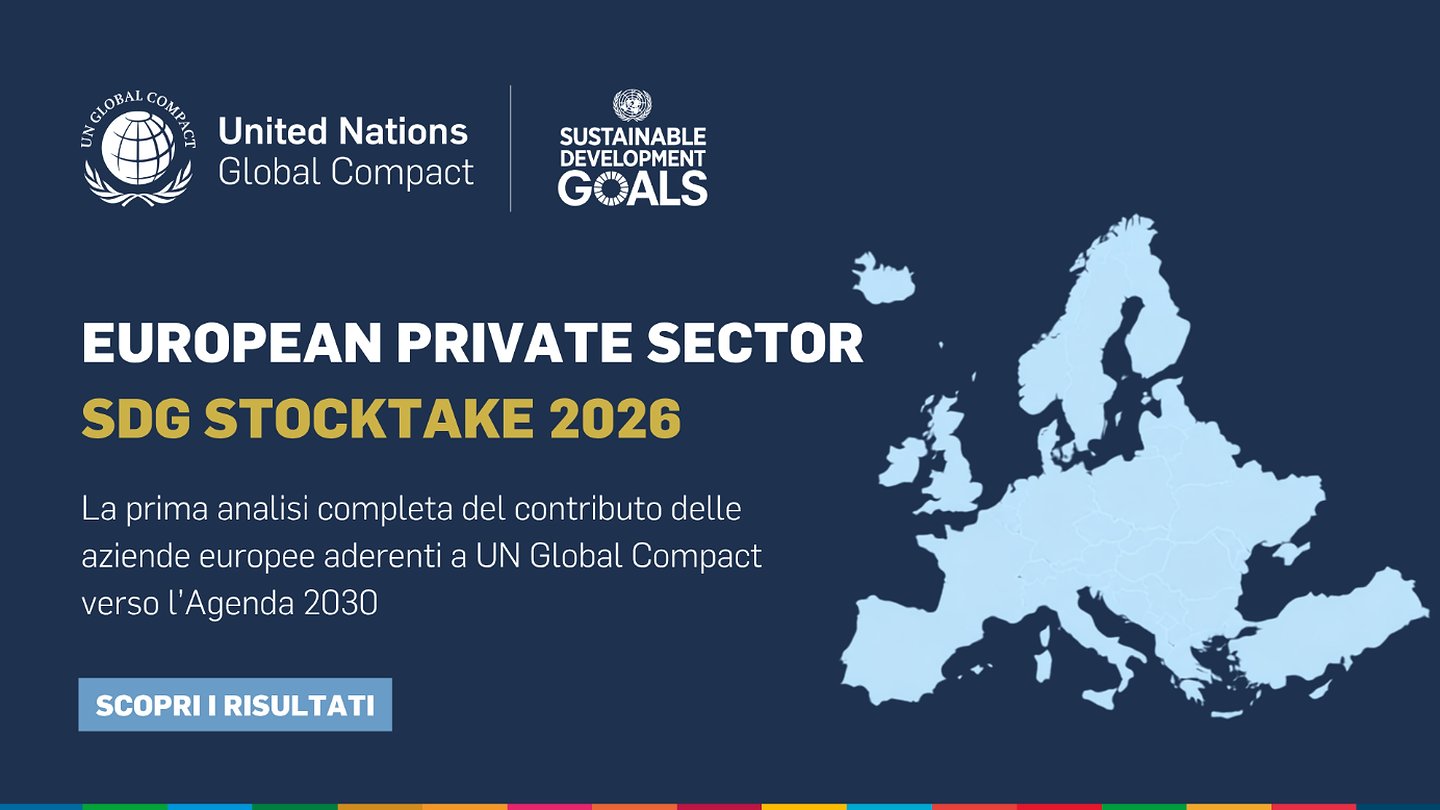
On the occasion of the United Nations General Assembly, UN Global Compact Networks Bulgaria, Finland, France, Germany, Italy, United Kingdom and Türkiye are releasing the second edition of the European Private Sector SDGs Stocktake.
Drawing on 136 data points from 5,793 UN Global Compact participant companies across 21 European countries, the study makes it possible, for the first time, to estimate the private sector’s level of contribution to the Sustainable Development Goals. The overall average contribution score of 58.2 out of 100 suggests a positive level of contribution to sustainable development, with room for improvement on specific issues.
Key findings
■ European UN Global Compact participant companies make a tangible contribution to the Sustainable Development Goals, with an overall average contribution score of 58.2 out of 100.
For each analysed SDG targets, a contribution score from 0 to 100 was calculated using a set of indicators, with 0 meaning no contribution at all and 100 the highest possible level of contribution. The scores reveal that while differences between countries are relatively small, the level of contribution remains uneven across the Goals. SDG 3 on health records the highest contribution score (73.6).
■ Companies’ contribution is higher on SDGs related to social issues than the ones related to the environment. Anti-corruption is well integrated by UNGC companies in Europe.
This difference may reflect longer-standing regulations in Europe on social issues, as well as a greater number of operational indicators for measuring environment-related SDGs, which require a higher level of maturity in terms of sustainability.
■ European industrial participant companies tend to embed environmental practices more deeply.
Overall, contribution to climate change (SDG 13) remains moderate among European participant companies, with an average score of 45.8. Only 28.1% of responding companies have developed a climate adaptation plan. The indicators suggest that industrial companies tend to contribute more to SDG 13 on climate and SDG 12 on responsible consumption and production than service-sector companies, suggesting that more direct exposure creates a stronger incentive to act.

■ The contribution scores by country show a degree of homogeneity in Europe.
The highest overall contribution scores have been calculated for companies from Greece (67.3), Türkiye (63.9) and Italy (62.8), as opposed to lower scores in Poland and Denmark (51.7) and Switzerland & Liechtenstein (54.6). Most countries fall within ± 2.9 points around the European average overall score. This suggests that companies in Europe now operate within broadly shared sustainability frameworks, with similar levels of regulations and expectations.
■ Most companies have now taken policy commitments and implemented internal prevention measures, but it remains difficult for most to translate these commitments into operational actions.
This is particularly the case for SMEs, who account for 56% of the responding companies. Employee training on sustainability also remains an area where progress is needed, given that its wide-scale implementation is essential to the implementation of the SDGs.
■ The efficiency of sustainability actions is still not systematically measured for all areas
Among the companies who have implemented sustainability measures related to social issues, only half have measured their progress. This is however significantly more common for measures related to the environment, despite 20% of companies still not tracking their efficiency. Sustainability training (SDG 4) also leaves room for improvement as less than 40% of companies offer such training to their employees on social and environment issues.
■ Multi-stakeholder and public-private partnerships show room for improvement among European companies participating in the UN Global Compact.
This is shown by a low contribution score on SDG 17 (22.1), and can be explained by the voluntary nature of such partnerships. Publi-private partnerships present a real opportunity for further progress and to drive a measurable impact in all sustainable development areas, notably in technological progress and financing.

The recommendations of the UN Global Compact
Based on these findings, the European Global Compact Country Networks who contributed to this study issue four recommendations to the European private sector:
- Increase progress measurement in all sustainability areas, to efficiently measure impact and ensure alignment with Sustainable Development Goals.
- Adaptation to climate change should become a priority for all sectors in Europe, to ensure the long-term viability of business models.
- Engage in more multi-stakeholder and public-private partnerships, such as cross-sector alliances, multi-stakeholder cooperation on innovative sustainable projects, or public-private finance mechanisms for supporting sustainable development.
- Increase sustainability training opportunities for all employees and suppliers, to ensure that sustainable impact can be positively delivered through the entire value chain.